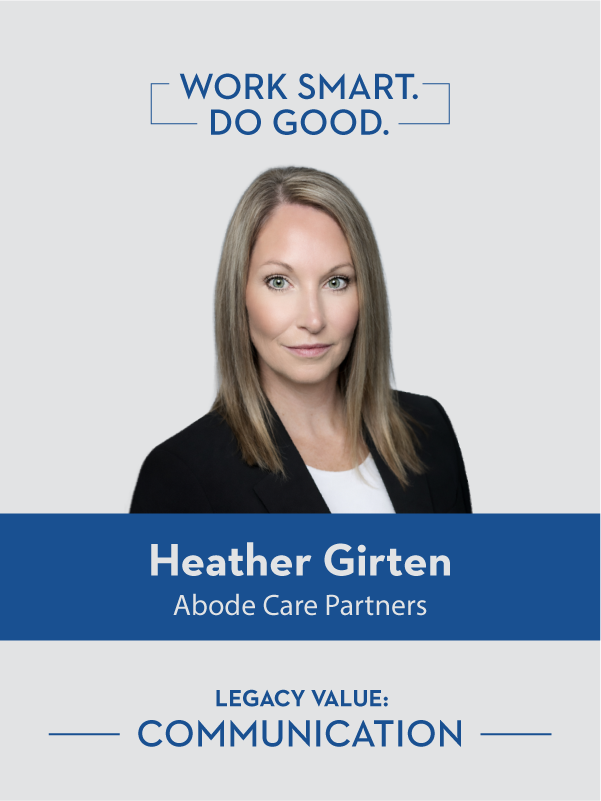
Abode Care Partners Nurse Practitioner (NP) Heather Girten has been Working Smart and Doing Good in Owensboro, KY. Lauded by colleagues at Signature HealthCARE of Hillcrest and throughout western Kentucky, Heather’s approach embodies BrightSpring’s LEGACY value of Communication, built on the kind of active listening that makes patients feel safe and keeps care teams working from a position of real understanding.
Heather is known throughout the facility as someone who takes genuine time with a patient before acting — not just reviewing the chart but engaging the full picture of what the person is experiencing. When a resident’s condition declined recently and emotions were running high, Heather worked closely with nursing staff and the family to ensure clear communication, comfort-focused care, and that the patient’s wishes were honored throughout. Colleagues describe her as knowledgeable, precise, and deeply attentive — someone who treats every interaction as an opportunity to build trust.
What makes me feel most proud is being able to advocate for my patients while also supporting their families. Building trust, improving quality of life, and knowing that I can make even a small positive difference in someone’s day is incredibly rewarding.” – Heather Girten
The people in Heather’s care feel the difference her presence makes. Patients feel heard and safe, families have confidence that their loved ones are truly understood, and the nursing team benefits from a provider who treats collaboration as part of the job. Her willingness to slow down and listen carefully ripples outward through every patient interaction and every care planning conversation she is part of.
Great work, Heather. Your commitment to Communication — especially the listening that makes it meaningful — keeps patients and care teams connected and confident. Because of the way you engage with every person you serve, individuals feel seen and the teams around you are better prepared to provide compassionate care.
According to the Centers for Disease Control and Prevention (CDC), over 14 million (1 in 4) older adults in this country experience a fall every year, and 50-75% of nursing home residents experience falls annually. These accidents are a leading cause of fatal and nonfatal injury for this population. Globally, falls are the second leading cause of unintentional death, and there are approximately 646,000 fatal falls every year. The highest rate of fall-related deaths globally is in those individuals over age 60.
Of course, not all falls result in a serious injury. Sometimes, an older adult may just have some scrapes or bruises. However, according to CDC data, about 37% of reported falls result in an injury that requires medical treatment or limits activity for a day or more. At the same time, about one million older adults are hospitalized every year because of a fall injury, most commonly a hip fracture or head injury; and falls are the most common cause of hospitalizations or deaths due to traumatic brain injuries (TBIs).
The domino effect of falls is significant, as these accidents often lead to loss of independence. For instance, one study showed that falls are linked to increased and often persistent ADL impairment. Inability to perform ADLs often contributes to the need for an older adult to enter a senior living community such as an assisted living facility or nursing home. After people have experienced a fall, and sometimes even when they haven’t but feel vulnerable, fear of falling can have a negative impact. Another study concluded that fear of falling can impact quality of life in older people, decreasing their mobility and engagement in activities and socialization. At the same time, another report noted that fear of falling contributes to inactivity and depression.
Understanding & Managing the Risk
Falls assessment and prevention in senior living communities require a multi-pronged approach that looks at all aspects of each person’s conditions and medications, their habits and activities, and their environment:
Conditions: Various health conditions put older people at risk for falls. These include visual deficits, degenerative joint disease, disequilibrium, orthostatic hypotension, hyponatremia, osteoporosis, osteoarthritis, motor deficits or balance issues, muscle wasting, frailty, foot sores or pain, dementia, Parkinson’s disease, malnutrition and fatigue.
Medications: Many medication side effects, including drowsiness, confusion, depressed psychomotor functions, dizziness and loss of balance, can contribute to falls. Among the classes of medications that can cause or contribute to falls are benzodiazepines, non-benzodiazepine prescription sedatives, antipsychotics, anticonvulsants, antidepressants, opioids, anticholinergics and antihypertensives.
Habits/activities: These include alcohol or drug use/abuse, noncompliance with assistive devices (e.g., someone who has mobility issues but refuses to use a cane or walker) and hoarding behavior. It is worth noting that people who are more active may be at greater risk of falling. However, this doesn’t mean that their activity should be stopped or limited. It is important to balance risk with choice and autonomy. People, even in a senior living community, should be able to take some measured risks to enjoy quality of life.
Environment: Environmental factors that contribute to falls include poorly lit rooms or halls, slippery or uneven floors, obstacles (such as boxes, ottomans, piles of papers, or shoes), stairs, loose rugs or uneven flooring, or even pets.
The care team can work together to share information and observations that can help identify individuals at risk for falls and implement a care plan to keep them safe. Risk assessment should involve the entire care team, including CNAs, housekeeping and dietary staff, and others who interact regularly with residents and may observe changes in behaviors and environmental concerns.
Prevention Strategies
There are a wide variety of fall reduction and prevention interventions that have proven the be effective. These include:
When fall prevention addresses all the above issues, communities can develop strategies, including programs, policies, and procedures. For instance, one study observed that multifactorial (including exercise, education, environmental modification, and mobility aids) and exercise interventions were linked to reduced falls in numerous trials.
Of course, there is no cookie cutter approach to falls prevention. As David Smith, MD, CMD, president of Texas-based Geriatric Consultants, said, “Falls prevention is not unlike other complex problems in geriatrics in that it’s not one-size-fits-all. When multifactorial interventions are implemented without considering the needs, interests, and abilities of residents, they barely move the needle. You need targeted interventions.”
Medications Matter
Clearly, one key approach to preventing falls is to make sure residents’ medication regimens don’t contribute to their fall risk. Long-term care providers and pharmacists play a central role here. Specifically, they can:
Ensure residents and families get adequate education about medication use, side effects and drug-drug interactions, particularly those that can increase the chance of falling.
Perform comprehensive medication reviews to identify residents taking medications that can increase their fall risk and recommend safer alternative therapies.
Aid in discharges from the facility to home by ensuring the safe use of medications by residents and optimizing adherence.
The pharmacist also can help look at risk factors that may fly under the radar in falls assessment, such as low vitamin D levels. As Arif Nazir, MD, CMO, chief medical officer of Abode Care Partners, said, “Older individuals who low serum vitamin D concentrations are at increased risk for muscle mass loss, decreased strength, hip fractures and falls.”
Most falls are the result of multiple factors including underlying medical conditions, but there is a correlation between polypharmacy and fall risk. Proactive, interdisciplinary medication reviews with the pharmacist) should be a component of any fall prevention strategy.
Tai Chi, OEP, and Other Promising Solutions
In recent years, tai chi, a popular meditative discipline and low-impact exercise that involves flowing motions and deep breathing, has received attention as a promising for falls prevention. Several studies, including a recent one, concluded that tai chi may decrease the overall fall risk and have a positive impact on balance. Nazir said, “The National Council on Aging, CDC, and other expert sources have recommended tai chi in older adults for preventing falls. This is one example of an exercise that can help improve balance, gait and strength.” Smith added, “There is almost no downside to interventions like tai chi. You at least have the intrinsic value of engaging residents and keeping them active aside from any fall prevention benefits.”
Another promising intervention is the Ortago Exercise Programme (OEP), which originated at the University of Otago in New Zealand. This involves a person-centered approach designed to build strength and balance. Led by physical therapists during a 52-week course, the program involves progressively more challenging exercises. It has been proven to decrease falls and fall-related injuries, as well as the risk of mortality, in high-risk individuals.
Elsewhere, researchers studied a multidimensional, patient-centered, nursing led framework aimed at improving outcomes and reducing falls in older adults. A pilot program using the framework resulted in a 51% decrease in the fall rate from November 2022 to October 2023. One study showed the promise of a simulation-based interprofessional education program for falls prevention, which was designed to identify and address variations in staff response to a fall. The authors concluded that stimulation-based training was well received by staff and could be conducted easily. Another study discussed a communication tool developed to question attending physicians in nursing homes about patients who are at risk for falls and help develop specific risk-reduction strategies. The tool included questions about medications, osteopenia, vitamin D deficiency, vision, hearing, gait/balance, injury mitigation, altered mental status and more. It enabled effective communication and allowed nursing home care teams to be more proactive on targeted fall prevention efforts.
Forward Thinking on Falls
A strategy to address falls in senior living calls for a multipronged approach that involves the entire interdisciplinary team and engages residents and families. This strategy should be flexible and enable customization for each person that addresses their needs, interests and abilities. It also should balance resident safety with autonomy and choice.
While you may not be able to prevent all falls, by assessing and addressing risk, initiating person-centered programs and care plans and ensuring that all staff know their role in fall prevention, the result can be safer residents who enjoy the best possible quality of life.
Primary Care Chief Medical Officer Dr. Arif Nazir discusses how senior living providers need to provide older adults with more than just medicine in his guest column “Resident well-being – Is the prescription pad enough?” in McKnight’s Long-Term Care News.
BrightSpring Chief Medical Officer, Primary Care, Dr. Arif Nazir, published an article titled “Beyond Reporting and Enforcing: Innovating for Higher Medical Director Engagement” in the Journal of the American Geriatrics Society.
A recent study published in JAGS by Goldwein et al. [1], along with an accompanying editorial [2], once again highlights the gaps associated with the role of medical directors in skilled nursing facilities (SNFs). The study underscores key aspects such as the reporting of administrative tasks, the distinction between administrative and clinical responsibilities, and, at best, minimal influence of compliance and regulatory standards. Despite ongoing discourse on this subject, significant gaps remain, particularly concerning the impact of the medical director role, and the critical question persists: will this renewed attention catalyze actionable stakeholders into some action?
E. L. Goldwein, R. J. Mollot, M. E. Dellefield, M. R. Wasserman, and C. A. Harrington, “Medical Director Presence and Time in US Nursing Homes, 2017–2023,” Journal of the American Geriatrics Society 73, no. 1 (2024): 29–38, https://doi.org/10.1111/jgs.19161.
D. Zwahlen and J. Luxenberg, “The Tip of the Iceberg: A Call to Improve Medical Director Presence, Time, and Training in US Nursing Facilities,” Journal of the American Geriatrics Society 73, no. 1 (2025): 6–7.
Effective July 1, 2023, all home-based primary care services offered by BrightSpring Health Service affiliates, including Western Reserve Medical Group and SHC Medical Partners, are now called Abode Care Partners. While our names are changing, we’ll continue to provide integrated medical services for all care settings.
Primary Care Chief Medical Officer, Dr. Arif Nazir, had an article published in the Journal of the American Medical Director’s Association titled “Handling With Care: Attending to Staff Burdens in Implementation of Quality of Care Initiatives in Nursing Homes.”
We use technologies like cookies to store and/or access device information. We do this to improve browsing experience and to show (non-) personalized ads. Consenting to these technologies will allow us to process data such as browsing behavior or unique IDs on this site. Not consenting or withdrawing consent, may adversely affect certain features and functions.
Functional
Always active
The technical storage or access is strictly necessary for the legitimate purpose of enabling the use of a specific service explicitly requested by the subscriber or user, or for the sole purpose of carrying out the transmission of a communication over an electronic communications network.
Preferences
The technical storage or access is necessary for the legitimate purpose of storing preferences that are not requested by the subscriber or user.
Statistics
The technical storage or access that is used exclusively for statistical purposes.The technical storage or access that is used exclusively for anonymous statistical purposes. Without a subpoena, voluntary compliance on the part of your Internet Service Provider, or additional records from a third party, information stored or retrieved for this purpose alone cannot usually be used to identify you.
Marketing
The technical storage or access is required to create user profiles to send advertising, or to track the user on a website or across several websites for similar marketing purposes.